
The average person will own seven backpacks in their lifetime, yet most never learn the fundamental principles that separate a $200 investment that lasts a decade from a $50 mistake that falls apart in six months. Whether you’re preparing for your first solo adventure, upgrading your daily commute gear, or planning a multi-week expedition, understanding how to choose a backpack that matches your specific needs can transform your experience from frustrating to effortless.
The right backpack becomes an extension of your body—you forget you’re wearing it. The wrong one? It’s a constant reminder of poor planning, featuring sore shoulders, a sweaty back, and the nagging feeling that you’ve made an expensive mistake. In this guide, I’ll walk you through the exact framework I use to help people select backpacks that actually work for their lifestyle, not just look good in product photos.
Understanding Backpack Capacity and Size
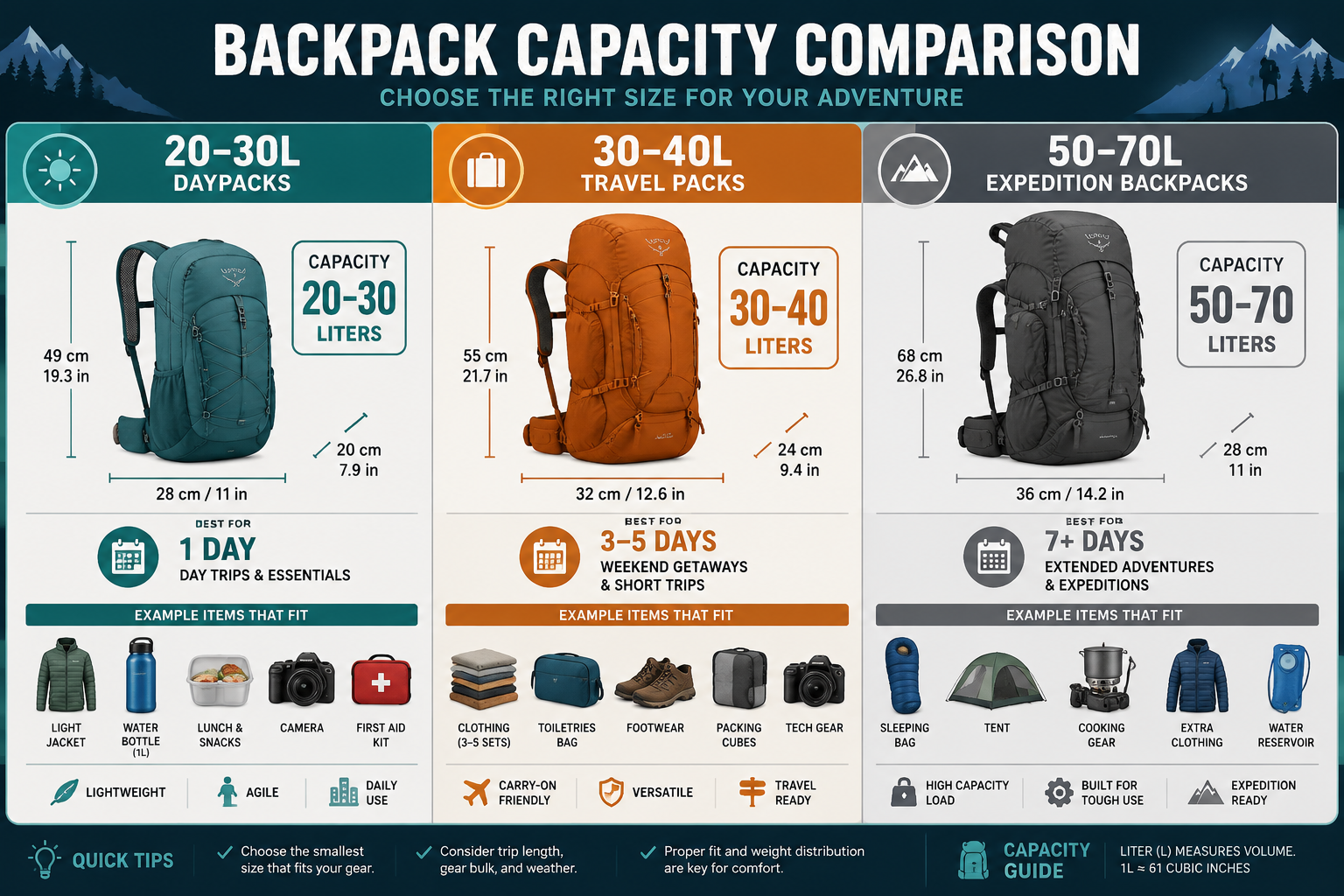
When learning how to choose a backpack, capacity is your starting point. Measured in liters, capacity determines what you can carry—but bigger isn’t always better
Capacity Ranges Explained
20-30 Liters (Daypacks) 📦
Perfect for daily commutes, school, or day hikes. These packs hold a laptop, lunch, water bottle, and a light jacket. If you’re looking for budget-friendly back-to-school options, this size range dominates the market.
30-40 Liters (Travel Packs) ✈️
The sweet spot for carry-on travel and weekend trips. This capacity handles 3-5 days of clothing, toiletries, and electronics without checking a bag. Most budget travel backpacks fall into this category, offering maximum versatility for urban exploration and short adventures.
40-50 Liters (Versatile Backpacking) 🏕️
Ideal for 3-5 day backpacking trips with moderate gear. These work for ultralight multi-day treks or as generous travel packs for those who need extra space.
50-70+ Liters (Expedition Packs) ⛰️
Reserved for week-long wilderness trips, winter camping, or expeditions requiring specialized gear. These packs feature advanced suspension systems and load-transfer technology.
The Under-Filling Problem
Here’s what most guides won’t tell you: an under-filled large pack performs worse than a properly-filled smaller pack. Extra space means items shift around, throwing off your center of gravity. The pack’s frame and suspension are engineered for specific load ranges, and running them half-empty creates awkward weight distribution.
I recommend choosing the smallest pack that comfortably holds your typical load. If you’re planning a European trip, check out what to pack for Europe to gauge your actual capacity needs before buying.
How to Choose a Backpack Based on Your Primary Use
The biggest mistake people make? Buying a “do-everything” backpack. In reality, design requirements for different activities are fundamentally incompatible.
Travel Backpacks
Key Features:
- Clamshell or panel-loading access (like a suitcase)
- Lockable zippers for security
- Laptop sleeve and organization pockets
- Stowable straps for checking as luggage
- Carry-on compliant dimensions
Travel packs prioritize quick access and organization over weight distribution. Popular 2026 models like the Aer Travel Pack 4 and Cotopaxi Allpa 35L exemplify this category with their urban-friendly designs.
For solo travelers, pairing the right backpack with proper planning makes all the difference—explore our guide to the best places to travel solo for destination-specific packing advice.
Hiking and Backpacking Packs
Key Features:
- Internal or external frame for load transfer
- Padded hip belt (carries 80% of weight)
- Adjustable torso length
- Hydration reservoir compatibility
- External attachment points for gear
Backpacking packs focus on comfort under heavy loads over long distances. The suspension system—frame, hip belt, and shoulder harness—matters more than any other feature. These packs rarely include laptop sleeves or TSA-friendly organization because they’re built for trails, not terminals.
Planning a camping trip? Your backpack choice should align with your camping checklist and campsite setup strategy.
Work and EDC (Everyday Carry) Packs
Key Features:
- Padded laptop compartment (specify size: 13″, 15″, 16″)
- Quick-access front pocket for phone, keys, wallet
- Professional appearance
- Comfortable for public transit
- Weather-resistant materials
Work packs emphasize protection and accessibility [9]. You need to grab your laptop in seconds, not unpack half your bag. The best work backpacks balance technical protection with office-appropriate styling.
School Backpacks
Key Features:
- Book a compartment with organizational pockets
- Durable construction (handles daily abuse)
- Comfortable padding for heavy textbooks
- Water bottle pockets
- Reflective elements for safety
School packs need to survive lockers, bus floors, and being tossed around [7]. Durability trumps weight savings for students.
Getting the Right Fit: Torso Length and Adjustments
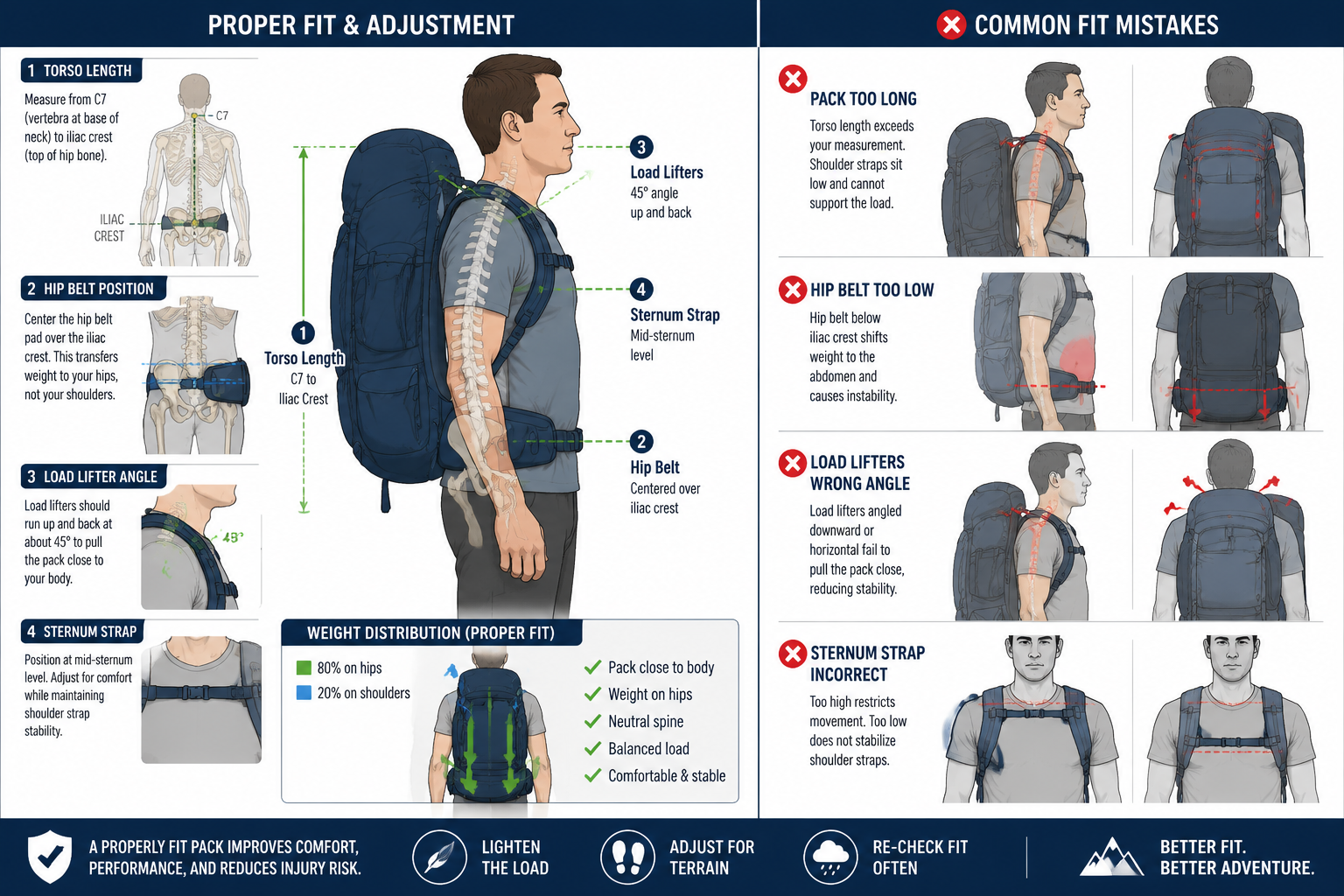
Even the most expensive backpack fails if it doesn’t fit your body. Here’s how to choose a backpack that actually fits.
Measuring Your Torso Length
Step 1: Tilt your head forward and feel for the prominent bone at the base of your neck (C7 vertebra).
Step 2: Place your hands on your hip bones (iliac crest)—where your hands naturally rest on your hips.
Step 3: Measure the distance between these two points. This is your torso length, not your height.
| Torso Length | Pack Size |
|---|---|
| 15-17 inches | Extra Small |
| 16-18 inches | Small |
| 17-19 inches | Medium |
| 18-21 inches | Large |
| 20+ inches | Extra Large |
Many quality packs offer adjustable torso lengths, accommodating multiple sizes in one pack.
The Hip Belt Test
The hip belt should rest on your iliac crest (hip bones), not your waist. This positioning transfers 80% of the pack’s weight to your legs and pelvis—your body’s strongest load-bearing structures.
Proper fit indicators:
- ✅ Hip belt sits on hip bones, not waist
- ✅ Load lifter straps angle 45° from pack to shoulders
- ✅ Shoulder straps contact your entire shoulder without gaps
- ✅ Sternum strap crosses your chest 2-3 inches below your collarbone
Warning signs of poor fit:
- ❌ Shoulder pain after 15 minutes
- ❌ Hip belt rides up to your waist
- ❌ Load lifters pull straight back (not angled)
- ❌ Gaps between the shoulder straps and your back
The 10-Minute Loaded Test
Never buy a backpack without this test:
- Load the pack with 20-30 pounds (realistic weight)
- Adjust all straps properly
- Walk around the store for 10 minutes
- Pay attention to pressure points, rubbing, or discomfort
If the pack feels uncomfortable empty, or with minimal weight, it will be unbearable when fully loaded on day three of your trip.
Essential Features and Materials
Understanding how to choose a backpack means knowing which features justify higher prices and which are marketing gimmicks.
High-Priority Features
YKK Zippers 🔒
The industry standard for durability. Main compartment zippers endure thousands of cycles—cheap zippers fail first.
Water-Resistant Materials
Ripstop nylon (210D-500D) or polyester with DWR (Durable Water Repellent) coating protects your gear from light rain. True waterproofing requires a rain cover or dry bags inside.
Ventilated Back Panel
Mesh suspension or channeled foam reduces sweat buildup. Critical for warm climates and active use.
Compression Straps
Stabilize loads and reduce pack volume when partially filled. Essential for multi-purpose packs.
Nice-to-Have Features
- Laptop sleeve: Suspended padding protects from drops
- Hydration reservoir sleeve: Keeps water accessible on trails
- Hip belt pockets: Store snacks, phone, or camera without removing the pack
- Trekking pole attachments: Free your hands on technical terrain
- Luggage pass-through: Slides over rolling suitcase handles
Features to Skip
Excessive pockets: More pockets = more weight and complexity. Most people use 3-4 pockets regularly.
Integrated rain covers: Often poorly designed and add weight. A separate cover or pack liner works better.
Gimmicky tech: Built-in speakers, solar panels, or excessive branding rarely justify the cost or added weight.
Price vs. Value: When to Spend More
Budget backpacks ($30-$80) work fine for occasional use, but daily users and travelers benefit enormously from mid-range ($100-$200) or premium ($200-$400) packs.
Where Premium Prices Matter
Suspension Systems: Advanced load-transfer technology in hiking packs justifies $250-$400 price tags for serious backpackers.
Warranty and Repairs: Brands like Osprey, Gregory, and Arc’teryx offer lifetime warranties and repair services—your $300 pack may outlast three $100 packs.
Materials: High-denier fabrics, reinforced stress points, and quality hardware extend lifespan dramatically.
Where Budget Options Excel
For students, gym-goers, or anyone needing a simple daypack for light use, $50-$80 packs from reputable brands deliver excellent value. Check out our best budget travel backpacks for specific recommendations.
Testing and Breaking In Your New Backpack
Once you’ve selected your pack, proper break-in prevents problems on the trail or during travel.
The 30-Day Break-In Process
Week 1: Wear the empty pack around the house for 30 minutes daily, adjusting straps to find your optimal settings.
Week 2: Add 10-15 pounds and take short walks. Note any pressure points or rubbing.
Week 3: Load to 75% capacity and take a 2-3 hour hike or long urban walk.
Week 4: Full load test on terrain matching your intended use.
This gradual approach reveals fit issues before your big trip and allows materials to conform to your body.
Common Mistakes When Choosing a Backpack
After helping dozens of people select backpacks, I see the same errors repeatedly:
Buying for “someday” trips: Choose for your actual lifestyle, not aspirational adventures. That 70L expedition pack is overkill if you take one camping trip per year.
Ignoring gender-specific designs: Women’s packs feature shorter torso lengths, narrower shoulder straps, and hip belts shaped for wider hips. These aren’t marketing—they’re biomechanical necessities.
Choosing by brand alone: Every manufacturer makes excellent packs and mediocre ones. Evaluate each model individually.
Skipping the fit process: “Medium” varies by brand. Always measure your torso and test with a weight.
Prioritizing looks over function: That sleek minimalist pack might photograph well, but lack the support your back needs.
Conclusion
Learning how to choose a backpack comes down to matching design to purpose, prioritizing proper fit, and investing strategically in quality. Start by defining your primary use case—travel, hiking, work, or school—then select capacity based on realistic needs, not aspirational ones. Remember that a 30L pack that fits perfectly outperforms a 50L pack that doesn’t, regardless of price.
The right backpack disappears into your routine, supporting your adventures without demanding attention. Whether you’re planning a beach vacation, exploring Switzerland, or simply commuting to work, your backpack should enhance the experience, not complicate it. Take the time to choose wisely, and you’ll wonder how you ever managed with anything less.
References
[1] Best Travel Backpack – https://www.packhacker.com/guide/best-travel-backpack/
[2] How To Choose A Backpack – https://www.columbia.com/how-to-choose-a-backpack.html
[3] How To Choose A Backpack – https://eumeworld.com/blogs/news/how-to-choose-a-backpack
[4] Best Backpack – https://www.outdoorgearlab.com/topics/travel/best-backpac


